Number Match - Number Games
- 4.8
- Rating
- 50.00M
- Installs
- Free
- Price
 Analysis by App-foxy
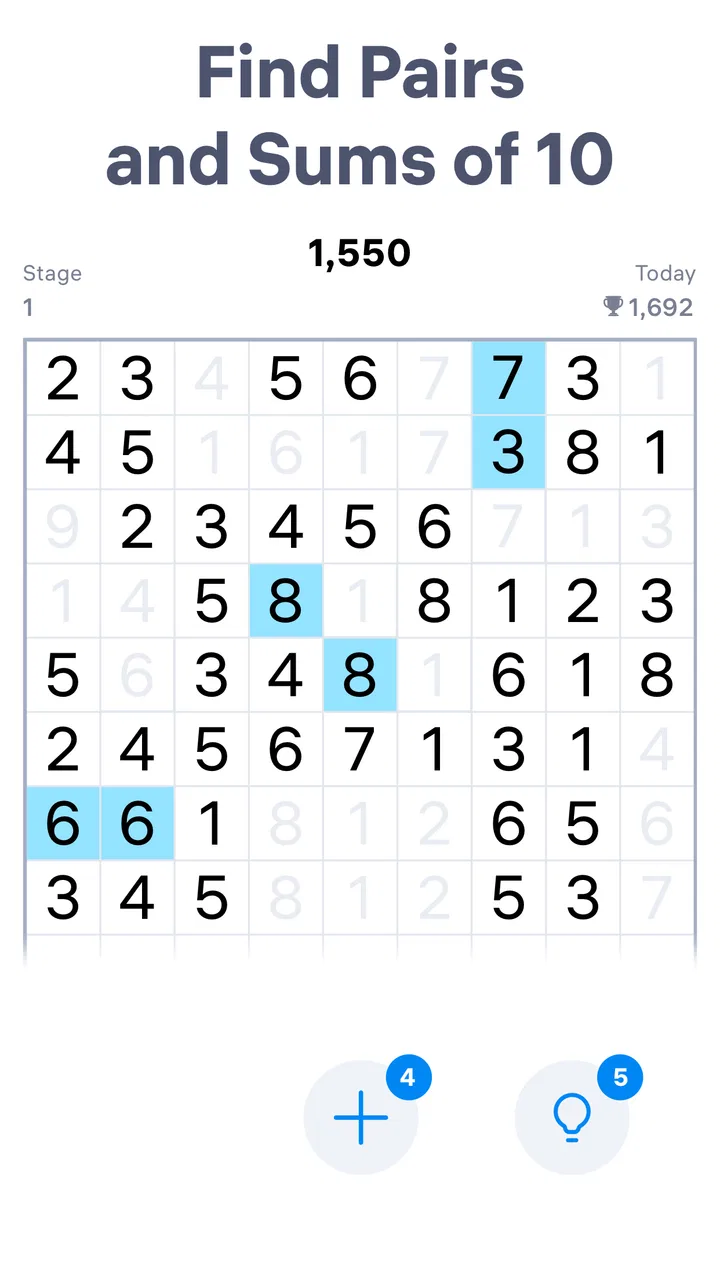
Number Match - Number Games is the kind of puzzle I open when I want something quiet, focused, and easy to understand within a few seconds. It is a free number puzzle from Easybrain, built around clearing a board by finding matching pairs. The rule sounds simple, but the interesting part is deciding which pair to remove first so that the remaining numbers stay useful rather than leaving the board in an awkward state.
I found it more thoughtful than a basic matching game because progress depends on planning, not just spotting identical symbols. It works well for a short break, although a single puzzle can also pull me into a longer session when I keep seeing one more possible move. Its Everyone rating makes it approachable for a broad audience, and its large community—more than fifty million installs, with an average rating of 4.6 from roughly five hundred fifty-nine thousand ratings—suggests that the format has found a substantial audience.
How the number boards turn a simple rule into a real puzzle
The central task is to locate pairs of numbers that can be cleared from the board. That immediately creates a small decision-making problem: a pair that looks convenient now may be less valuable than another pair that opens space or preserves future options. I like that the game does not require complicated controls or a long tutorial. The challenge is visible on the board, and the player’s attention goes straight to the arrangement of the numbers.
You May Also Like

 Blood Strike: 2.5 Anniversary
Blood Strike’s Loadouts Turn Every Drop Into a Tactical Gamble
A close look at Blood Strike’s custom loadouts: how fast access to signature weapons reshapes its battle royale rhythm, rewards preparation, and narrows the gap between fights.

 Pandora - Music & Podcasts
Pandora’s Music Is Easy to Start, but Harder to Recover
Pandora’s strength is its low-effort path from a seed to a station. Its weak spot is how much confidence it asks you to place in connection, setup, and quiet recovery.

 8 Ball Pool
 Is Built on Rivalries, Rematches, and Routine
A close look at the rivalries, rematches, shared routines, and unanswered safety questions that turn a quick pool match into a persistent mobile community.

 Samsung Music
’s Quiet Strength Is Playing What You Already Own
Its reach comes less from spectacle than from dependable access to a personal library. That simplicity is both the app’s strongest retention engine and its ceiling.

 AccuWeather: Weather Radar
AccuWeather Review: A Quick, Clear Forecast for Everyday Decisions
For everyday plans, the best forecast is the one you can understand quickly. AccuWeather makes rain timing, radar, and local conditions easy to act on, with a few trade-offs.

 Hill Climb Racing
Why Hill Climb Racing Still Turns Crashes Into One More Run
A tiny car, a bumpy hill and one more upgrade: Hill Climb Racing keeps resurfacing because its simple chaos makes every near-miss feel personal.
More From Our News Desk
View All News


That simplicity is also what makes the game suitable for everyday use. I can start it while waiting for an appointment, during a short commute as a passenger, or between tasks when I want something more engaging than scrolling. The visual language is based on numbers rather than a large collection of special characters, so the board feels more like a compact logic exercise than a reflex game.
In my experience, the best way to approach a board is to avoid immediately taking the first pair I notice. I first scan for pairs that may be blocking other numbers or creating a clean route through the layout. This is one of the less obvious strengths of the game: it rewards a short pause before acting. The difference between a comfortable board and a frustrating one can come from one early choice.
The game also suits players who enjoy familiar number puzzles but want something less demanding than a full strategy title. It does not ask me to memorize a complicated system, manage a large collection, or learn a long list of abilities. The mental work is local and concrete. I look at the current board, identify relationships, and decide what to remove next.
That does not mean every session feels equally satisfying. If I prefer fast feedback, dramatic effects, or constant changes in pace, the measured number-board format may feel repetitive. The appeal comes from concentration and pattern recognition, so players looking for action, story, or competitive matches should probably choose another type of game.
Small decisions matter more than quick tapping
A useful habit is to treat each available pair as part of a chain rather than as an isolated reward. Before clearing one, I check whether it will expose a useful number, separate a crowded area, or leave several possible matches available. This approach makes the game feel less random, even when the board initially looks busy.
Another practical tip is to change the way I scan the screen. Instead of searching only for identical numbers, I look at the surrounding spaces and ask what the board might look like after a removal. That extra step helps when several pairs are available. It also prevents the common mistake of choosing a pair simply because it is the easiest one to see.
This is where Number Match differs from very casual matching games. In many alternatives, the main satisfaction comes from fast recognition and immediate clearing. Here, the more rewarding moments come from preserving options. It is closer to a light logic exercise than to a purely visual matching activity, even though the controls remain simple.
What progress feels like during ordinary play
The game is easy to fit into different moods. When I have only a few minutes, I can focus on one section of the board and stop without needing to remember a complicated storyline. When I have more time, I can slow down and examine the consequences of each move. That flexibility is valuable for a puzzle game intended for phones, where interruptions are common.
There is also a subtle pressure that comes from watching the available choices shrink. Clearing numbers feels positive, but every removal changes the remaining puzzle. I sometimes feel tempted to act quickly because a visible pair looks like progress, yet the better move may be the less obvious one. The game therefore creates pressure through decision-making rather than through a timer or an action sequence that demands rapid reactions.
For a realistic everyday example, I would use it during a lunch break when I want to reset my attention without committing to a full game. I can play carefully for a short period, put the phone away, and return later when I need another mental pause. It is especially useful when I am tired of social feeds but do not want a demanding game that requires sound, fast reflexes, or a large time investment.
On the other hand, this same rhythm may not suit someone who wants a clear sense of long-term achievement after every session. Number puzzles can feel self-contained. If the main reason for playing is to build a character, unlock a narrative, or compete directly with friends, this experience may seem limited. Its satisfaction comes from solving the board in front of me, not from a broader adventure.
Spending, free access, and the pressure to continue
The game is free to download, with in-app purchases listed at $14.99 per item. That is the important spending context I would keep in mind before installing it. A free entry point makes it easy to try the core puzzle without paying first, while the purchase price means I would still review any purchase prompt carefully rather than treating every optional item as automatically worthwhile.
I do not think the presence of a purchase option alone makes the game unfair. The more useful question is whether I can enjoy the number puzzles without feeling pushed to spend. In my own approach, I would begin with the free experience, play enough sessions to decide whether the board design genuinely holds my attention, and only then consider whether any paid item solves a problem I actually have.
There is a practical trade-off here. Players who value a completely uninterrupted puzzle experience may be more sensitive to any commercial prompts or limits they encounter. Players who only want an occasional number challenge may find the free starting point sufficient. Since spending preferences vary widely, I would avoid purchasing impulsively during a frustrating board; difficulty can make an optional purchase look more necessary than it really is.
A sensible routine is to set a personal rule before playing: enjoy the free version first, do not buy simply to escape one difficult moment, and check the item’s purpose before confirming. That advice is particularly relevant for younger players, even though the content rating is Everyone. The age rating describes broad suitability, not a guarantee that every household will want purchases enabled without supervision.
Fairness for solo puzzle players
Number Match is primarily appealing as a personal logic challenge, so fairness is less about defeating another player and more about whether the board gives me a meaningful chance to think. I judge it by the quality of the decisions it asks me to make: can I improve my result through better observation, or does the outcome feel disconnected from my choices?
The strongest form of fairness in this kind of game is transparency in the puzzle itself. I can see the numbers and choose the pair. That makes the experience feel more accountable than a system where progress depends mainly on hidden rewards or unpredictable opponents. When I make a poor choice, I generally understand that the board became harder because of my decision.
There is still a limit to what I would call competitive fairness. This is not a direct multiplayer contest, and I would not install it expecting a ranked environment, live opponents, or an esports-style test of skill. Its large rating base shows broad interest, but popularity should not be confused with head-to-head competition. The right comparison is with other solo logic games, not with competitive puzzle platforms.
Compared with sudoku, it feels more immediate because I can start matching numbers without filling a grid according to several rule types. Compared with classic tile-matching games, it asks for more forward planning and less rapid visual reaction. Compared with crossword puzzles, it is less dependent on vocabulary and more dependent on spatial scanning. Those differences make it a good alternative for someone who likes structure but wants shorter, more visual decisions.
Sudoku may be better for players who enjoy a carefully defined deduction system and a longer uninterrupted solve. A traditional match-three game may be better for someone who wants quick combinations and more visual excitement. Number Match occupies a middle ground: simple to learn, but deliberate enough that careless moves can matter.
Who will enjoy it, and who should skip it
I would recommend it to people who like calm puzzles, number patterns, and games that can be played in small pieces. It is also a good choice for anyone who wants to train their habit of scanning before acting. The board gives enough information to support thoughtful play, while the rules remain approachable for someone who does not usually play complex strategy games.
It is less suitable for players who need constant novelty or a strong narrative reason to continue. If repeated number layouts feel dull to you, the game may become a background distraction rather than a lasting hobby. I would also skip it if my main goal were social competition, because the appeal is the individual challenge of making good choices on a board rather than proving myself against another person.
People who dislike purchase prompts should approach the free download with clear expectations and keep spending controls in mind. The listed price of $14.99 per item is significant enough that I would not tap through casually. The best experience for a cautious player is to treat the free version as a trial and make any later decision deliberately.
Device expectations and the version to look for
The current version is 1.42.0, and the game supports devices running Android 8.0 or newer. That makes checking the operating system worthwhile before trying to install it on an older phone or tablet. For most people with a reasonably recent Android device, the requirement should be straightforward, but older hardware can still be a deciding factor.
Because the game is based on a board of numbers rather than complex action scenes, I see it as a natural fit for a phone used in short sessions. I would still make sure the screen is comfortable to read and that touch input is reliable, since the entire experience depends on selecting the intended numbers accurately. A small or damaged display could make careful scanning more tiring than the puzzle itself.
The developer is Easybrain, a name associated here with a focused puzzle format rather than a broad role-playing or action experience. The game was released on April 30, 2021, so it is not a brand-new experiment, but its continued presence and substantial install base indicate that the basic concept has remained relevant to many players.
What I would check before committing to it
My first check would be whether the free play loop feels satisfying without spending. I would not judge it after one rushed attempt, because the game’s appeal becomes clearer when I slow down and make deliberate choices. I would play several short sessions and notice whether I enjoy the thinking itself or merely the act of clearing numbers.
My second check would be how I respond to difficulty. A good puzzle should make me want to reconsider my approach, but not make every failure feel like a reason to purchase something. If I find myself tapping through prompts because I am frustrated, I would stop and reassess rather than assuming payment is the natural solution.
My third check would be whether the format fits my preferred pace. Number Match works best when I am willing to pause, scan, and plan. It is not the right choice for a quick reflex session. That distinction can save time: the game may be well made for its purpose and still be wrong for someone who wants speed.
I would also consider the audience using the device. The Everyone rating makes it broadly accessible, but family members should still agree on how in-app purchases are handled. A child may understand the puzzle immediately while not understanding the spending consequences of a purchase screen. Clear device-level controls are a sensible part of using any free game with paid items.
My trust verdict after weighing the trade-offs
My overall view is positive, with a clear condition: Number Match is worth trying if I want a solo number puzzle that rewards patience more than reflexes. The rule is accessible, the board encourages planning, and the short-session format fits real phone use. I especially like that a seemingly small move can change the shape of the remaining puzzle, giving the game more depth than its simple presentation suggests.
I would not describe it as a universal recommendation. Players seeking story, direct competition, or constant action will likely be happier elsewhere. I would also approach the purchase system carefully, because free access and paid items require different expectations. Starting without spending is the most sensible way to find out whether the core loop earns a place on the phone.
My final recommendation is to try it as a calm, thoughtful puzzle rather than as a high-energy game. If you enjoy examining a board, preserving options, and learning from a poor move, it can become a reliable companion for short breaks. If you want the game to entertain you through spectacle, social rivalry, or a deep progression system, choose a different category instead. For the right player, its restraint is the attraction: the numbers stay simple, while the decisions gradually become more interesting.
FAQs for Number Match - Number Games
01What is the main objective of Number Match - Number Games?
Number Match - Number Games is designed to challenge your numerical and logical thinking skills. The main objective is to match pairs of numbers to clear them from the board, aiming to clear all numbers to progress through levels. It's a great exercise for your brain, combining fun with mental agility.
02Is Number Match - Number Games suitable for all age groups?
Yes, Number Match - Number Games is suitable for players of all ages. The game is designed with varying levels of difficulty, making it accessible for both younger players and adults looking for a brain-teasing challenge. It's user-friendly and can help improve concentration and problem-solving skills.
03Does Number Match - Number Games require an internet connection?
Number Match - Number Games can be played offline, which means you don't need an internet connection to enjoy the game. This makes it perfect for playing on the go, whether you're commuting or simply in an area without Wi-Fi access. However, some features may require connectivity, such as updates or leaderboards.
04Are there in-app purchases within Number Match - Number Games?
Yes, Number Match - Number Games offers in-app purchases. These can include additional hints, themes, or removing ads to enhance your gaming experience. While the game is free to download and play, these optional purchases help support the developers and offer additional conveniences for players.
05Is there a way to track progress or compete with friends in Number Match - Number Games?
The game includes features that allow you to track your progress through levels and achievements. Additionally, you can connect with friends or compete on leaderboards to see how you rank against other players. This social aspect adds a competitive edge and encourages repeated play to improve skills.
Pros
- Engaging puzzles that stimulate the mind.
- Simple interface for easy navigation.
- Regular updates with new levels.
- Offline mode available for uninterrupted play.
- Minimal ads for a better user experience.
Cons
- Limited hints can be frustrating for beginners.
- No multiplayer mode for social gaming.
- Repetitive sound effects may annoy some users.
- In-app purchases can become costly.
- Lacks variety in background themes.

Number Match - Number Games
Gallery